
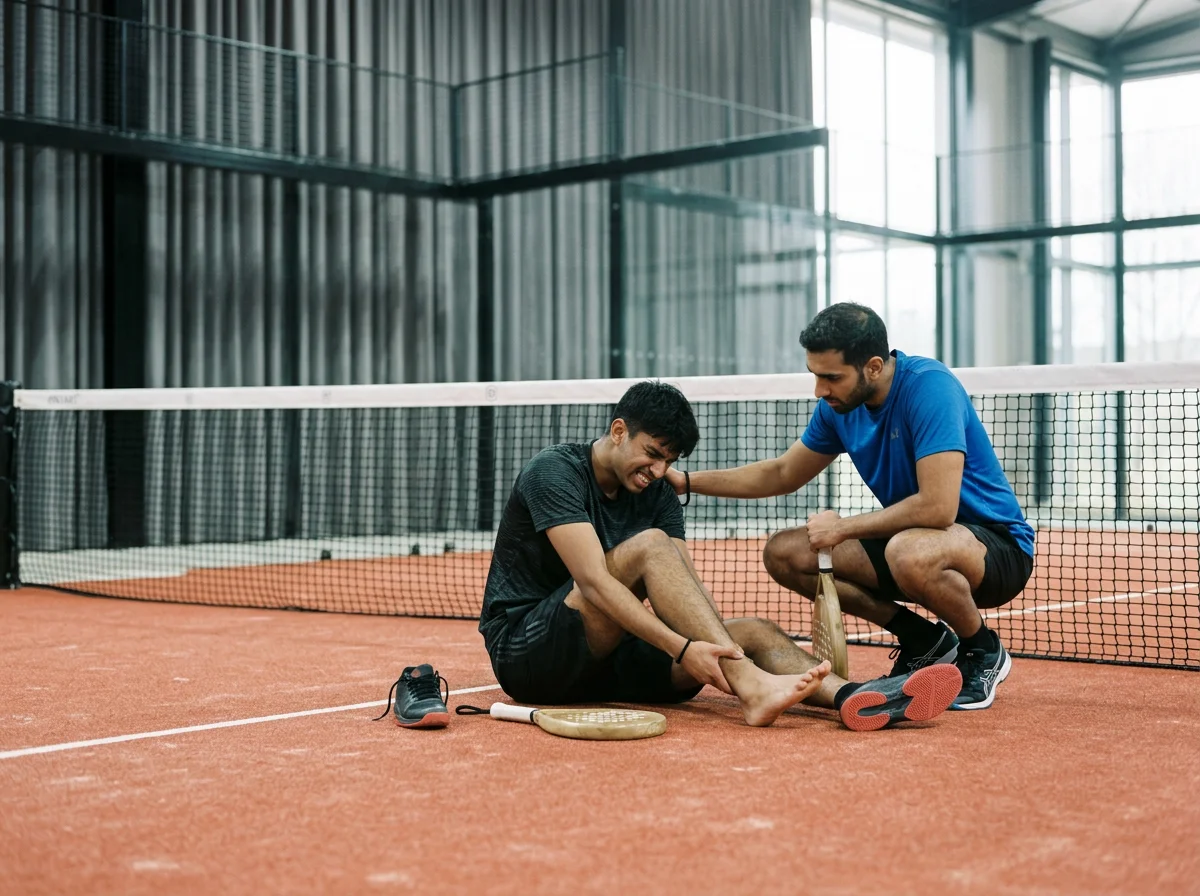
This week I watched a player go down mid-rally. One explosive step for a lob, a sharp pop, and they were hopping off court holding the back of their leg. It's a moment I see again and again in clinic, and it's one of the most preventable injuries in the sport.
How common is it?
Padel is booming across London, and injuries are rising with it. A 2023 systematic review found an injury rate of about 3 per 1,000 training hours and 8 per 1,000 matches. The calf accounted for 14% to 22% of injuries, putting it alongside the elbow, shoulder and knee as the most affected areas. A 2026 scoping review of 13 studies and 3,581 players found muscle was the most commonly injured tissue.
What actually happens
The usual culprit is the inner calf muscle, the medial gastrocnemius. It tears when it contracts hard while the knee is straight and the ankle is bent upwards. That's exactly the position of an explosive push-off to chase a ball. Players often describe it as feeling like someone kicked or hit them in the back of the leg.
Not all tears are equal
We grade calf tears from 1 to 3 by severity, from a few torn fibres to a complete tear. But severity is only half the story. Recent research on 115 calf injuries showed that where the tear sits matters. Tears involving the calf's free tendon sheet, the aponeurosis, took the longest to return to play. That's why two players with "the same" injury can be back on court weeks apart, and why proper assessment matters.
Return to play is earned, not dated
At Recoverie Health, we don't clear players on a calendar. We clear them on criteria. That means pain-free function, full ankle range, calf strength and endurance within 10% of the other leg, and pain-free hopping, sprinting and lateral movement. Only then do we build back through padel drills to match play. Rushing back is the biggest risk factor for a second, worse tear.
Prevention is strength
Most calf tears happen to calves that were never trained for the demands of padel. Short, explosive, repeated efforts need a calf with strength, endurance and spring. Warm-ups help, but they don't replace capacity.
Tired of getting injured?
We're launching padel-specific strength and conditioning classes at Recoverie Health, built by physiotherapists who treat padel injuries every week. Spaces will be limited.
Rush, Physiotherapist and co-founder, Recoverie Health
Sources: Incidence, prevalence and nature of injuries in padel: a systematic review (2023, PMC10277135). Epidemiology, Incidence, Prevalence, and Treatment of Injuries in Padel: A Scoping Review (Applied Sciences, 2026). Epidemiology of injuries in padel and preventive recommendations (2024). Calf injury in a padel player, medial gastrocnemius classification (2024).