
Pilates won't fix your osteoarthritis.
If you've been told to "just try Pilates" for your joint pain, you deserve the full picture. Not a partial answer.
Let's be honest. When your GP, your friend, or the internet suggests Pilates for osteoarthritis, they're not wrong. They're just not finished. Pilates can be genuinely helpful. But if you're living with OA and you've been banking on mat classes alone to turn things around, there's something important you should know.
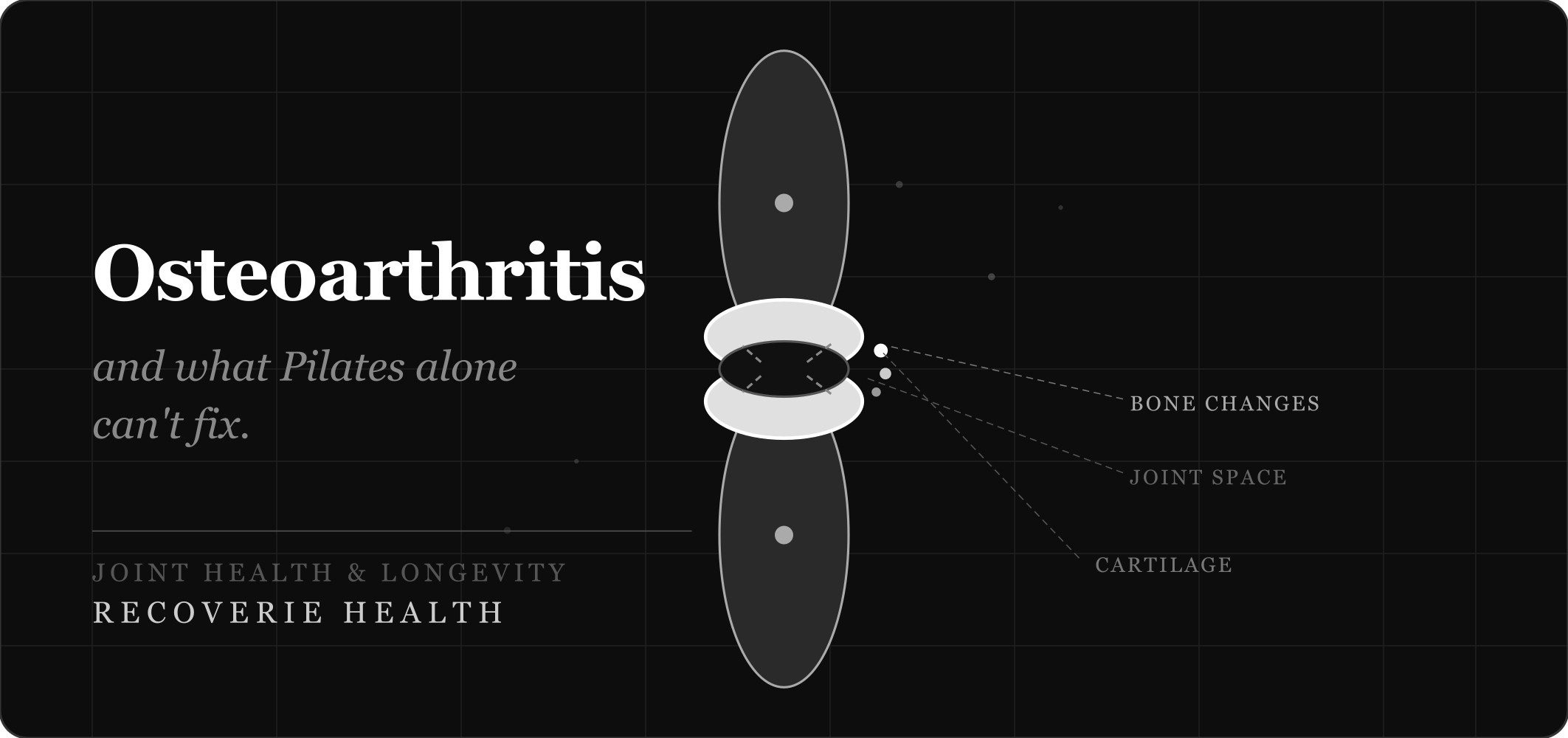
Osteoarthritis is not simply a "weak core" problem. It's a complex, progressive condition involving cartilage breakdown, bone changes, joint inflammation and the way your muscles, tendons and movement patterns all interact over time. A one-size-fits-all exercise class, however well-intentioned, can only address part of that picture.
1 in 6 UK adults live with osteoarthritis
40% report their symptoms are poorly managed
8.75M people in the UK affected
So what's missing?
Pilates builds flexibility and body awareness. Both valuable. But it typically lacks the load-bearing, progressive resistance work that joints actually need to adapt and strengthen. Research consistently shows that resistance training and targeted physiotherapy produce stronger outcomes for OA sufferers than flexibility-based exercise alone.
"Movement is medicine. But the dose and the type matter enormously."
Without a proper clinical assessment, you can't know which muscles are compensating, which movement patterns are loading your joints incorrectly, or whether you're gently rehabilitating or quietly making things worse. That's not a reason to be afraid of movement. It's a reason to make sure your movement is guided.
The Recoverie approach
At Recoverie Health, we don't dismiss Pilates. We contextualise it. For many of our clients, elements of Pilates-style movement are woven into a broader, clinically informed programme that also includes:
A COMPLETE OA PROGRAMME INCLUDES
Comprehensive physiotherapy assessment to understand your specific joint picture
Progressive strength and resistance work to support and offload affected joints
Gait and movement analysis to correct patterns that accelerate wear
Pain education so you understand what OA actually is and why that matters
Longevity-focused lifestyle guidance covering nutrition, sleep and recovery
Regular reassessment so your programme evolves as you do
The goal isn't to discourage you from moving. Quite the opposite. It's to make sure every session, every rep and every stretch is actually working in your favour and not just filling time before things get worse.
Should you quit Pilates?
Probably not. But it shouldn't be your only strategy. Think of Pilates the way you might think of a good night's sleep. Valuable and necessary, but not a substitute for medical care, the right nutrition or a structured recovery plan.
If your pain is being managed, if you're getting stronger, if your range of motion is improving and your quality of life is genuinely better then great. Keep going. But if you've been doing classes for months and things aren't changing or are quietly getting worse, that's your sign to go deeper.
"The best exercise for osteoarthritis is the one tailored to you. Not the one that's most popular this year."